


There is a specific kind of magic in enjoying a holiday highlight reel, but nothing compares to the quiet realisation that you have actually moved somewhere new. It is the moment you stop being a tourist and start weaving yourself into the fabric of a different country. For 10 months of 2025, we traded the slow travel rhythm for a full-on working life in Osaka, Japan.
We feel incredibly lucky to have been able to call Japan home in 2025 and it was absolutely worth cutting out honeymoon short to leave the Kiwi summer and dive into the depths of Osaka's winter. Japan is such a rich, beautiful, and sometimes bafflingly efficient country. Living and working there gave us a deep look into the inner workings of Japanese society and really felt like we got a sense of what day-to-day life is like there as we lived through the seasons. We got to see the quiet discipline, the unspoken cultural norms, and the incredible dedication to craft that makes the whole country hum.
Summarising such a weird and wild journey as 2025 is no easy task, but here it goes…
What is The World Expo?
First and most important question: what on earth were we doing there?
Often referred to as the “World’s Fair”, the World Expo is a massive global event that takes place every 5 years in a different host country around the globe. It is a mammoth festival where nations from every corner of the earth gather to showcase their latest ideas, culture, and technological breakthroughs. If you’ve ever seen / been to one of those specialty “trade shows” like that random “kitchen expo” or “baby expo” in your local neighbourhood. It’s effectively the same thing, but just on an unbelievably large scale. The World Expo is a platform for governments, businesses, and citizens to congregate for 6 months and celebrate human progress. Imagine if Disneyland, a UN summit, and Burning Man all came together with their unique and best bits…that would be the World Expo. One part amusement park, one part geopolitical gathering, and one part cultural art festival.
The event itself has been going on since 1851, starting with the “Great Exhibition” in London. Since then, host nations have built elaborate temporary cities that often leave behind iconic legacies after their conclusion. Some of the most famous landmarks to come out of the World Expo are the Eiffel Tower for the 1889 Paris Exposition (see link here) and the Space Needle for the 1962 Seattle World's Fair (see link here). It even was the name of the first Canadian Major League Baseball team “The Montreal Expos” which was a nod to the hugely successful Expo67 event hosted there (the team was subsequently moved to Washington D.C. and renamed the “nationals”).
This rendition of the World Expo was held in Osaka, Japan, operational 7 days a week for 6 months straight. Osaka is the second largest metropolitan area in the country after Tokyo. This was the second time Expo has been hosted in Osaka as it was also the host in 1970. We actually took the time to visit the old Expo site as it has now been converted into a lovely legacy park that visitors can still enjoy today.
The theme of this rendition of Expo was “Designing Future Society for Our Lives,” which is admittedly a bit vague. Every participating country interpreted this in a different way (or didn't apply the theme at all), leading to a variety of experiences. There were 188 different uniquely built temporary structures (or 'pavilions') to see, and they varied wildly in size, style, and scope. There were national pavilions where countries showed off their best innovations / ideas alongside local Japanese company or regional thematic pavilions that focused on specific concepts, innovations or corporate visions. To be honest, even after working there for months, we still struggle to fully understand how to clearly articulate what it really is. But it's a fun day out for families! There is also an unspoken "soft power" that operates behind the scenes,. It felt like a high-stakes game of cultural influence, and we suspect that this has a lot to do with its continued relevance.
The entire site was built on Yumeshima, a reclaimed artificial island in Osaka Bay. Every rendition of Expo has a feature piece (see above Eiffel Tower & Space Needle) and the undeniable star of this Expo was the “Grand Ring”. A massive wooden circular structure with a circumference of 2kms (1.24 mi) that acted as the main delineation and walkway for the Expo. It even earned a Guinness World Record as the largest wooden structure in the world. It was a gorgeous piece to walk beneath but it was especially cool because visitors could take an escalator up to stand on top of it which offered a view of the entire mini-city below, with different perspectives at day and night. We especially loved heading up for the nightly sunset, fireworks and drone shows. It was a pretty incredible reminder of the scale of the project we were part of and Luke even had a fun little morning routine of running around it before our workdays with colleagues.
We both had the distinct privilege of working at the USA Pavilion, which was undeniably one of the most popular spots at the Expo. After how much of a hit USA was at the Dubai Expo in 2021, the pressure was on to deliver something even better in Japan. While we have to keep some of the "behind the scenes" magic under wraps, we can definitely give you a tour of what made the USA pavilion so special.
The theme was "Imagine What We Can Create Together," and consisted of two massive multi-story triangular wings connected by a suspended, glowing cube that floated between them.
Inside, visitors walked through a series of exhibition rooms which showcased American ideas, culture, landscapes, and innovation all broadly centred around the theme of Space exploration with large 31-foot tall LED screens, model rockets, and cool lights on full display. The emotional peak was “the Crescendo Cube”, where a rocket launch simulation took you from Florida to Mars and beyond in an immersive experience with enough bass and smoke to actually shake the floor. At the end of exhibitions we even had a genuine Moon rock from one of the Apollo Space Mission which was pretty neat. The legacy of this was linked to the USA Pavilion in the 1970 Expo in Osaka, where a piece of the moon was displayed - the first time it had ever been taken outside of the USA. This was a major draw for locals to come visit, and with 95% of the up to 250,000 visitors per day at Expo being local Japanese, that resulted in full occupancy at the USA Pavilion every. single. day. throughout the 6 months. Many of the older Japanese visitors said their main reason for returning was to see it because they remembered the famous moon rock from the last Expo so long ago!
To round it all out, there was a restaurant serving culinary staples like Cheeseburgers, while cohorts of musicians and performers were inhouse on the outdoor stage with American Country, Jazz Musicians, Native American dancers and other amazing talents. The “star” of the show, however, was our adorable mascot, Spark. Most pavilions had their own little cute mascot to represent their unique identity because the Japanese public absolutely adore them. People went totally wild for Spark. They bought up every bit of merchandise we had for sale. Spark was so cute, and she guided visitors through each room of our pavilion with a little song. To a first-time visitor, it was catchy and playful. To us, after hearing it for the 10,000th time (our windowless office was directly below the exhibit), it was a special, special kind of mental test.
While each pavilion had its own personality, the main face of the whole event was the overarching Expo mascot, Myaku-Myaku. The word "Myaku" means "pulse" or "vessel," in Japanese and the design was a shapeshifting creature made of cells and water. To be perfectly honest, when we first saw it, we (along with most people) thought it was genuinely bizarre and creepy. It is a blue, watery body topped with a red, circular head of "cells" that features multiple eyes. At certain angles, you can even spot the extra eye on his rear. However, in typical Japanese fashion, the weirdness eventually became endearing. People really rallied behind this strange little cell-creature. By the end of our 10 months, we had fully converted and became big fans ourselves. There is something about the weirdness of the design that eventually wins you over. There was even a little theme song to go along with the whole Myaku-Myaku / Expo2025 theme which was super catchy and fun (link here)
The Japanese were absolutely nuts about the Expo, and they especially loved the USA Pavilion. At one point during the peak of summer, the gate was seeing about 250,000 patrons Every. Single. Day. About 10,000 of those guests would wait in a 3.5 hour line in the sweltering heat just to visit our pavilion. We even had a little livestream showing the gate with thousands of people waiting in eager anticipation to sprint to the USA pavilion right when the gates opened. It was quite a site to watch. Needless to say, both the entire event and our pavilion were a raging success. It was very refreshing to see thousands of people engaging with the best parts of USA and walking out with a positive impression.
One part of the experience that made the Expo (and Japan) particularly memorable and fun was their stamp and pin culture. Japan has a long-standing tradition of "stamp rallies," where people collect unique rubber-stamp designs at train stations, shrines, and tourist spots to commemorate their journey. Expo took this to the next level with an official “Stamp Passport”, allowing visitors to collect over 200 unique stamps from various pavilions and facilities around the site, including several limited edition stamps. Some were easy to get but others were hidden within pavilions which were impossible to get into so it became a bit of a fun challenge to collect them all including the novelty pins that each pavilion handed out. It's great marketing and an incentive for people to explore not only Expo but wider Japan because these stamps were literally everywhere.
With the motivation of the stamp passport, we took the opportunity to see many of the pavilions during our time at Expo, some of which we only could get into given our connections through working there. Unfortunately, some were impossible to enter as we weren't eligible for the convoluted reservation system at some local pavilions.
Some of our Favourite Pavilions:
The German Pavilion: This was one of the few pavilions that strictly followed the brief (Designing Future Socieities for Our Lives). The entire pavilion was a living prototype for sustainability, built with materials like rammed earth, hempcrete, and even fungal mycelium that could be composted or recycled afterward. Even the surrounding garden was circular, with plants borrowed from local nurseries only for the duration of the Expo. The geo-location personal mascot, Wa, which spoke 3 languages and screamed if you tried to take it home with you was also a highlight!
The Gundam Pavilion: Gundam is a massive Japanese media franchise centered on giant piloted robots (kind of like Transformers). It is a cultural icon in Japan, and their pavilion, titled "Gundam Next Future," featured a massive, 17-meter (55 ft) tall standing Gundam statue at the entrance and an immersive video experience that made you feel like you were touring a space station in the year 2150.
The Japan Pavilion: As the host nation, expectations were incredibly high, and they certainly delivered. The pavilion was a beautiful, massive structure made of cross-laminated timber that looked like a giant piece of traditional joinery. Inside they demonstrate how we might produce food and oxygen in the future using algae. It was a fascinating mix of ancient craftsmanship and futuristic science, all focused on the harmony between technology and nature. Their pavilion mascot was a special algae version of Hello Kitty, iconic.
The Gas Pavilion: One of our favorite thematic pavilions at the Expo was the Gas Pavilion. It sounds like it might be a bit dry or industrial, but it was actually a total riot and one of the most playful experiences on-site. Ironically, this pavilion was all about gas, but it took a very creative approach to explaining the "harmful" side of CO2 and the importance of a carbon-neutral future.
The experience was designed to show how gas can be treated and recycled to protect the planet. The journey culminated in a massive, interactive theater where everyone in the audience put on AR headsets at the same time. Suddenly, we were all transported into a digital world where we had to work together to take on a "big bad" evil gas character representing pollution. Seeing a room full of people waving their arms and cheering as they collectively fought a cartoon villain was hilarious, but it really drove home the message of global cooperation in the fight against climate change.
Expo was easily one of the longest and most demanding projects we have ever tackled. Most of our previous work follows a predictable pattern: a few months of lead-up in an office environment, a month of operational delivery onsite, and then a natural wind-down. This was different. It involved a very, very short runway to build operational plans from scratch, followed by six months of continuous, high-stakes, non-stop operations that felt like a marathon with no imminent finish line in sight.
It was honestly exhausting. Managing thousands of people across a massive site in the middle of a relentless Japanese summer really wore everyone down. The humidity was unforgiving and the pace never slackened, making it a true test of physical and mental endurance for the entire crew.
However, the silver lining was the incredible team we were a part of. We were working alongside a group of Americans from all across the U.S. (and a few extra international team members like Jelley), and there was something truly special about the friendships that formed in those trenches. Because we were all overcoming such a unique and difficult challenge together, we moved past being just colleagues very quickly. By the end, we weren't just a team, we were like a family. It was a massive collective effort, and knowing we were all in it together was the only thing that kept us going through the toughest shifts.
Japan Adventures
That’s a wrap on the Expo talk. We could talk about it for days. While work was intense, the real beauty of living in Japan was the opportunity to explore it! Fortunately, we worked on a 4 days on and 2 days off cycle. Since we were the ones responsible for making our respective teams rosters, we were lucky enough to sync our schedules up perfectly for the majority of the time. This gave us the opportunity to head off on many adventures all around Japan. It would honestly take a long time to explain them all in detail (and we recognise that we are a tad behind on our blog posts) so here is a brief run through of some of our absolute favourite adventures.
Kobe
When we first arrived in Japan, it was snowing and incredibly cold. However, the timing ended up being perfect because we arrived just as the country’s famous plum and cherry blossoms began to bloom. We took several trips to the neighboring cities of Kobe which is an easy train commute from Osaka. Kobe has a fascinating history as one of the first Japanese ports to open to foreign trade, giving it a unique, international feel. Some of our personal highlights included hiking to a stunning waterfall in the hills through a blizzard, learning the history behind the world famous Kobe beef, cheering on the Kobe Steelers rugby team (with many Kiwis in the squad!) and spending an afternoon trekking through a beautiful abandoned railway line.
Kinosaki Onsen
For our first real dip into Japanese bathing culture, we headed a few hours north out of Osaka to Kinosaki Onsen. In Japan, an “onsen” is a Japanese bathouse / hot spring / sauna. But is far more than that. It is a deeply ritualistic part of the culture that people participate in from a very young age to relax and connect. Kinosaki is a gorgeous little wooded town purpose-built for this very tradition. It is famous for having seven public bathhouses that you can hop between while wandering the willow-lined canals.
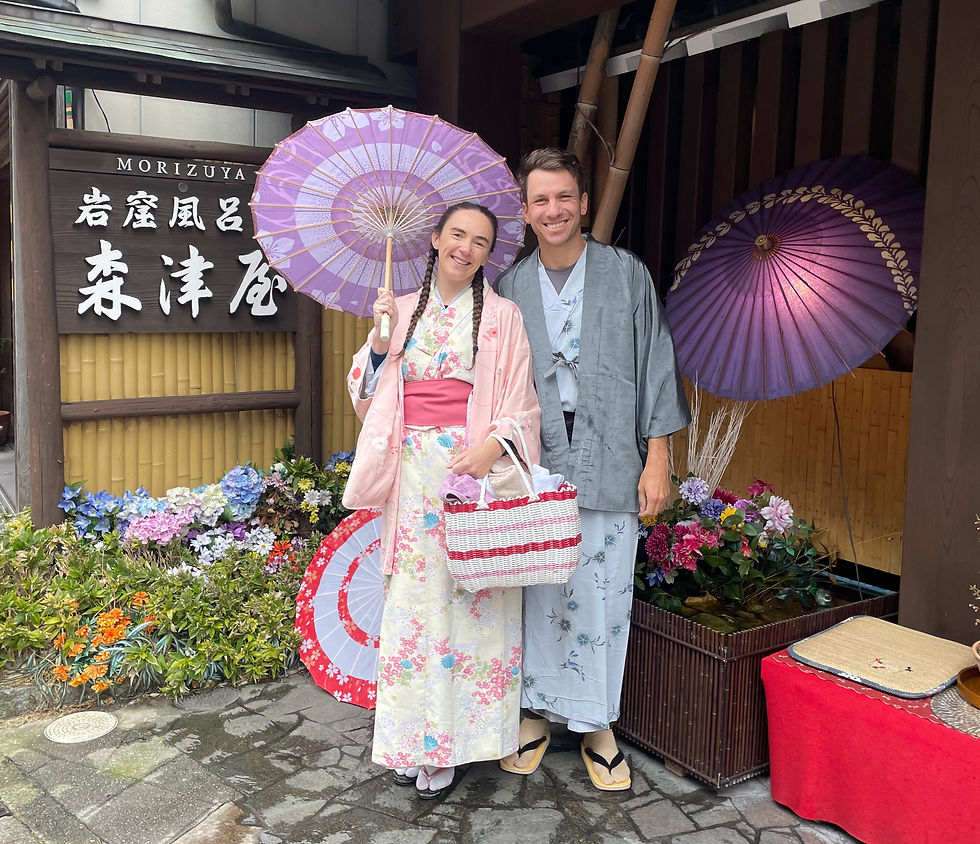
We travelled there by train and stayed the night at a traditional Ryokan, which is a classic Japanese inn featuring tatami mat floors and sliding paper doors (so cute!). We fully committed to the experience by putting on traditional yukata robes and the slightly ridiculous-feeling and highly impractical wooden sandals called geta , and our host was determined to capture the best photos throughout the town of us. We even took part in a traditional tea ceremony and shared an incredible multi-course meal.
We will admit we were super nervous about the onsen at first. Traditional onsen customs require you to be separated by gender and be completely nude, and many places are quite strict about being tattoo-free. However, once we understood the etiquette, we learned to love it. It was not weird at all; it was actually the perfect way to de-stress. Kinosaki was a highlight for us and a great way to get more familiar with the slower, more traditional side of Japanese life.
Kyoto
Another short train ride from Osaka lies Kyoto, the cultural and historic heart of Japan. As the former imperial capital for over a thousand years, it is world-renowned for its stunning concentration of well-preserved temples and traditional architecture.
We had some great individual adventures here, including a visit to the Kyoto Railway Museum to see the evolution of the famous Shinkansen. Luke headed to a Samurai museum with his buddy Dan to see the legendary weaponry of the ancient warriors, while Jelley explored the Arashiyama Bamboo Grove, where the towering green stalks create a natural cathedral. We also eventually made the obligatory stop to see the famous "1,000 Torii Gates." These vibrant orange gates are actually thousands of individual donations from people and businesses, forming a seemingly endless tunnel that winds up the mountainside.
Onomichi Bike Trip
On one of our days off, we joined some of our Argentinian colleagues for a cycling trip along the Shimanami Kaido. This is a legendary route that connects Japan’s main island to Shikoku by crossing six smaller islands in the Seto Inland Sea via a series of gorgeous suspension bridges. It was such a cool experience to ride across massive, world-class engineering marvels on a dedicated cycle path that stretches the whole way. Pedaling high above the blue water gave us a totally different perspective of the Japanese countryside and the stunning coastal scenery. It was a long day on the saddle, but seeing those impressive bridges up close made every kilometer worth it.
We also made a pit stop on the bike tour at one of the strangest and most fascinating places we found in Japan: Kousanji Temple. Right at the top of the temple grounds sits "The Hill of Hope," which is a massive, three-acre garden made entirely of white marble imported from Italy. It looks like a gleaming white Mediterranean acropolis dropped onto a lush Japanese island. Walking through the abstract marble towers and staircases was completely surreal and felt like we had accidentally stepped out of Japan and into a modern art museum in Greece. It was the perfect, bizarre break before we hopped back on our bikes to finish the trek.
Lake Biwa!
One of our absolute favorite spots to unwind during the sweltering summertime was Lake Biwa. It is Japan’s largest freshwater lake and sits just a short train ride away from the city. We loved that we could hop on a train and be in a stunning lakeside town in less than two hours. It has such a charming local feel, and it was incredibly relaxing to just hang out along the lake's beaches and enjoy the sunset over the water.
Beyond being a great place to cool off, Lake Biwa is actually one of the oldest lakes in the world, which means it has developed a totally unique ecosystem. It is home to over 60 endemic species that you cannot find anywhere else on Earth, including the Biwa trout and the round crucian carp (which is the star of a very funky fermented local sushi). The wetlands around the shore are also a major sanctuary for migratory birds and rare water plants, making it a real hidden gem for nature.
We ended up visiting three separate times and even ventured up a nearby mountain via a gondola. During the winter, this area is a popular ski field, but we caught it when the slopes were transformed into a massive, colorful field of daffodils during their full bloom. It was the perfect, peaceful contrast to the high-energy chaos of the city.
Sports
We also managed to catch plenty of live sport, which gave us a front-row seat to how Japan embraces international games. We went to several rugby matches and quickly realized why the sidelines sounded so familiar. Many of the players are actually from New Zealand and Australia, as many former pros head to Japan later in their careers. Ever since Japan hosted the 2019 Rugby World Cup, the sport has remains incredibly popular. We saw the Kobe Steelers play twice, and the energy in the stands was fantastic. And of course, we couldn't live in Japan without experiencing a baseball game. Baseball is a national obsession here, which makes sense given Japan is the home of superstars like Shohei Ohtani (Dodgers). While we were in Hiroshima, we went to see the Hiroshima Toyo Carps. By total chance, we happened to know the mascot of The Carps, and he hooked us up with free tickets. It was such a cute and lively experience, but the vibe is totally different compared to a game in America. The fans have coordinated but highly respectful chants and songs for every single player, making the whole stadium feel like one big, rhythmic celebration.
Koyasan
We had the opportunity to visit the mountain town of Koyasan twice, once on our own and again when Luke’s mom and sister came to visit. Koyasan is the center of Shingon Buddhism, a sect of Japanese Buddhism that has been practiced in these mountains for over 1,200 years. It is an incredibly enchanting place, secluded deep in the wooded mountains and filled with hundred of temples. Historically, the number of temples in Koyasan has fluctuated wildly. At its peak in the 15th century and again during the Japanese Edo period, the mountain town was home to between 1,800 and 2,000 temples. Today, there are 117 temples remaining on the mountain. Both times we visited, we stayed at different authentic Buddhist temples. Staying in a temple, or shukubo, means living alongside the monks, eating traditional vegetarian monk food, and waking up early to witness their morning prayers. Although Monk praying may not be for us (a bit too repetitive haha), walking through the moss-covered cemeteries and ancient cedar trees felt like stepping back in time. It is a deeply spiritual place and was easily one of the most peaceful experiences we had during our time in Japan.
Tottori Sand Dunes
One of the more surprising landscapes we encountered was the Tottori Sand Dunes. We headed there on a fun road trip with some colleagues and were blown away by the sight. You really do not expect to find massive, Sahara-like dunes in the middle of Japan, but it is just another example of how diverse this country's geography can be. The dunes stretch along the coast of the Sea of Japan and create a truly surreal atmosphere.
Right beside the dunes, we visited the Sand Museum, which was easily one of the most impressive things we saw. It is the world’s first indoor museum dedicated entirely to sand art, and the scale of the sculptures is mind-blowing. They invite the best sand sculptors from all over the world to create these massive, intricate scenes based on a different theme each year. All the sand in the museum is taken directly from the sand dunes. To think that these towering, detailed works of art are made of nothing but sand and water is incredible. Because the sculptures are eventually returned to sand to make room for the next exhibit, there is a beautiful, temporary nature to the whole place. While we were in the area, Luke also joined some of our wonderful work colleagues for a hike to the top of Mount Daisen offering incredible views of the area.
Shirakawa-go and the Japanese Alps
We took an extended trip to the historic village of Shirakawa-go, famous for its incredible "Gassho-zukuri" thatched-roof farmhouses. These steep, triangular roofs are designed like hands pressed together in prayer to withstand some of the heaviest snowfall in the world. It is a UNESCO World Heritage site that feels like stepping into a frozen moment of ancient rural Japan.
Afterward, we set off on a multi-day trek through the Japanese Alps. Many people do not realize that Japan is home to some of the most rugged and beautiful alpine ranges on the planet. There are even some wonderful skiing spots to visit! We started in Kamikochi, which is arguably the "Yosemite of Japan," and spent four days navigating epic mountain terrain before finishing at the Nakabusa onsen to soak our very sore bodies.
The hike was a big challenge, but the mountain hut system made it unforgettable. It is very similar to the New Zealand backcountry, where you can book a bed in a cabin along the trail, but the Japanese version takes it up a notch. These cozy huts serve hot, delicious Japanese meals even at high elevations, which is an incredible luxury after a long day of climbing. It reminded us a lot of the tea houses we stayed at while trekking in the Himalayas of Nepal.
What struck us most though was how few foreigners we saw on the trail; we only met one other traveler from Hawaii (who we are currently visiting while belatedly writing this post!!), while everyone else was local. We were constantly stunned by the fitness of the older Japanese hikers, many of whom were navigating the steep, technical ridges with total ease while pushing 70 years old!
The only nerve-wracking part was the bears. There had been several reports of attacks in the area during our trek, so we had to ring "bear bells" constantly to scare them off. Luckily, we had no close encounters! We finished the entire adventure soaking in a delightfully unique onsen, the ultimate reward for an epic journey through the clouds.
Hiroshima
We made a memorable trip down to Hiroshima with our good friend Caitlin. It was the dead of summer, and the Japanese heat is no joke, so we had to be strategic about when we ventured outside. We started with a walking tour of the city to soak in its history, which is defined by an incredible story of resilience and peace.
We made an obligatory visit to Ground Zero, the site where the atomic bomb was dropped on August 6, 1945. Seeing the A-Bomb Dome, the only structure left standing near the hypocenter, and walking through the Peace Memorial Museum was heavy and deeply moving, but we were grateful to learn the full weight of the city’s past.
To lighten the mood, we took a short ferry over to Miyajima Island. The island is famous for its "floating" Torii gate, which is one of the most iconic images of Japan. It is massive and built right in the water, so it appears to float during high tide. The island is also home to more friendly deer and some of the best grilled oysters we have ever tasted. We took a gondola up to the Shishi-iwa Observatory for the view, but it was so sweltering that we had to head back down pretty quickly to find some shade!
Of course, we had to try the local specialty: Hiroshima-style Okonomiyaki (a traditional fried noodle dish). Unlike the version in Osaka where everything is mixed together, the Hiroshima style is layered and features a generous portion of fried yakisoba noodles at the base. It was born out of post-war food shortages when people added noodles to make the savory pancakes more filling. While Osaka might be our "home" city, we have to admit we definitely preferred the Hiroshima style!
Hakone
Another highlight was our trip to Hakone with Caitlin. To get there, we took a series of charming local transports, including a historic mountain railway that was actually inspired by the famous Bernina Express/Rhaetian Railway in Switzerland. Hakone is essentially a massive, active volcanic caldera, and you can really feel that energy as you explore the area.
We took the Hakone Ropeway (a giant gondola) over the Owakudani volcanic valley. The ground below is literally steaming with sulfur vents, and the local specialty is "Kuro-tamago"—eggs boiled in the natural hot springs. The shells turn pitch black from the sulfur, and local legend says eating one adds seven years to your life! From the top, we headed down to Lake Ashi and hopped on a giant, kitschy pirate ship to sail across the water. Even though it was a bit foggy when we went, the mist just added to the mystery of the landscape.
While we were there, we also visited the Hakone Open-Air Museum, which features incredible sculptures set against the mountain backdrop, and the iconic Torii Gate of Peace. This gate is famous for standing directly in the waters of Lake Ashi; it was built in 1952 to commemorate the peace treaty after WWII and symbolizes a wish for Japan’s independence and future harmony. Seeing that bright red gate emerge from the fog was incredibly beautiful and well worth the trek.
Hosting Friends in Osaka
One of the best parts of staying in one place for an extended period was the opportunity to play host. After months of living there, we developed a fun little "circuit" of our favorite spots to show off the city and its surroundings. We took visitors to all the Osaka hotspots. The historic Osaka Castle, getting harassed by the famous bowing deer in Nara, and headed to the neon-soaked streets of Dotonbori to see the iconic Glico Running Man. We always made sure to end the night at our absolute favorite local sushi spot. As perpetual travellers that always seem to be taking people up on couch surfing opportunities, it was great to give back a bit of travel love.
Mt. Fuji
Another highlight was a visit from our good friends Vic and Andrew! Our first stop on our trip toward Japan's largest mountain was Aokigahara, also known as the "Sea of Trees." It is a beautiful, dense forest grown over ancient lava flows, but it was definitely spooky to walk through. The porous volcanic rock absorbs sound, creating an eerie, unnatural silence that has given the forest a somber reputation over the years. While it is a stunning natural site, it is also a place that carries a lot of weight in Japan, so we made sure to stick strictly to the trails and be respectful of the atmosphere.
We also rented bikes and spent the day touring around the shores of Lake Yamanaka and Lake Kawaguchi. Many people say that Mt. Fuji is "shy" because the peak is so often hidden behind thick clouds, and for most of our trip, he lived up to that reputation! However, our patience eventually paid off when the clouds finally lifted on our final morning, giving us an epic, clear view of the sunrise hitting the summit. We even took a few paddle boats out onto the lake to soak in the view from the water. It was such a quintessential Japanese experience to share with good friends.
South Korea
We took advantage of our proximity to Japan to make a quick, action-packed trip over to Seoul. We started with a bike tour through the historic center, where we watched the "Gwanghwamun Gate Guard Changing Ceremony." It felt remarkably similar to the Changing of the Guard in Britain, but with vibrant traditional Korean costumes and music. We also swung by the Blue House, the beautiful former executive office and residence of the Korean president.
During our downtime, we visited a cat cafe and cooled off with a bowl of Bingsu, a delicious traditional dessert of milky shaved ice topped with sweet treats. For the best perspective of the city, we headed up the N Seoul Tower, which offered sweeping 360-degree views of the sprawling metropolis below.
The highlight of the trip was meeting up with one of Luke’s old colleagues from his YMCA days. We shared an incredible Korean BBQ dinner followed by traditional tea and treats, which gave us a chance to chat with a local and learn more about the Korean way of life. We were particularly struck by how distinct the culture and energy of Seoul felt compared to Japan, despite them being such close neighbors. It was a short visit, but we definitely made the most of every minute!
Obama and Awaji Island
One extremely random trip we made was with a few equally as adventurous colleagues, their parents visiting from New Jersey, and our friend from Switzerland. They wanted to see the more unusual side of Japan, so we drove north to a town literally called Obama. While the town has no historical connection to the former U.S. President, they fully leaned into the name with a hilarious statue of him that bore almost no resemblance to the man himself. While there, we took a beautiful boat tour of the nearby granite sea cliffs, which were surprisingly rugged and scenic.
The next day, we upped the ante and headed to Awaji Island. Located just across the bay from Osaka, Awaji is a massive island that feels like a bizarre social experiment in tourism. The local government has been trying to inject life back into the area after decades of rural decline, resulting in some truly "offbeat" attractions. We drove across the Akashi Kaikyo Bridge, which is the second-longest suspension bridge in the world, to reach the island.
Once there, we took a boat out to see the Naruto Whirlpools, which are natural vortexes created by the massive volume of water moving between the Seto Inland Sea and the Pacific Ocean. To be honest, we aren't entirely convinced we saw actual whirlpools or just some random bubbles, but the boat ride was an adventure nonetheless! Afterward, we went to Nijigen No Mori, a surreal anime-themed amusement park where we actually got to zipline into a life-sized Godzilla’s mouth. It was a weird, wonderful, and totally off-the-beaten-path day that showed us a side of Japan most tourists never see. We were motivated to watch the original Godzilla movie for the first time after this experience.
Sendai and the Deep North
One of our final adventures in Japan was a trip up north to the Sendai region. We visited Lake Tazawa, a stunningly blue circular lake that holds the title of the deepest in Japan. The lakeside town itself felt oddly abandoned, a glimpse into the "ghost town" phenomenon affecting many rural Japanese villages. We found a charming, unique jazz-themed lodge to stay in that was full of character, and hired what we thought were e-bikes to tour the lake, but they turned out to be electric mopeds! We zipped around the entire circumference of the water, which was a total highlight.
During the trip, we hiked up to Yamadera, a breathtaking temple complex clinging to the side of a steep mountain, and reminded us a lot of the monasteries in Greece, also perched high on natural rock formations. The climb consists of over 1,000 stone steps through a lush forest, rewarding you with a famous view of the valley below. We were possibly the only non-Japanese tourists.
We ended the trip by venturing deep into the valley for one final, rustic onsen experience at Tsurunoyu Onsen in the Nyuto Onsenkyo village. Established in the 1600s, it is one of the oldest and most famous hot springs in the region. The site felt like a time capsule, with thatched roofs, moss-covered wooden buildings, and a tiny, ancient check-in counter.
What set this one apart was just how intimate it was. Luke had a particularly memorable encounter when he found himself sharing a tiny bath (no larger than 2 square meters or roughly 21 square feet)with 6 elderly Japanese men. Just when he thought he was getting comfortable with the onsen ritual, this "cozy" soak pushed him right over the edge! They even had a traditional mixed-gender bath, though we decided to skip that particular experience. Sendai region was an incredible way to see a more rugged, northern side of the country and partake in some “only in Japan” experiences.
Whilst we covered A LOT of ground throughout Japan, there were many prefectures and islands we did not make it to and could happily return for another 10 months .. and still not see it all!
Thoughts on Japanese Culture
We could talk for hours about Japanese culture. It is undoubtedly one of the most incredible places we have ever lived, and it is no surprise that tourism here is skyrocketing. If we had to boil it down, here are some of our favorite (and least favorite) parts of daily life in Japan.
Likes
Kawaii Culture: Everything in Japan is intentionally cute and small. From the tiny "Kei" cars that look like toys to the adorable characters on everything from safety signs to food packaging, the "culture of cute" makes the entire country feel incredibly charming.
7-Eleven and Family Mart: These are the pinnacle of convenience where you can grab a high-quality fresh fruit smoothie, use an ATM, or print documents. Luke even paid his pension here! It has everything you need and they're also literally EVERYWHERE in Japan. There are more 7-11's in Japan than anywhere else in the world (link here). It brought convenience to a whole new level.
Manhole Covers: Many cities treat their utility covers like street art, featuring intricate, colorful designs that represent local history or landmarks. It became a fun little activity to spot the manhole cover in each town and take a photo of it.
Temples: You are never far from a stunning temple or shrine, offering a quiet, spiritual escape right in the middle of a bustling city.
The Food: Eating out is incredibly cheap and delicious, with tiny hole-in-the-wall spots serving world-class meals for under ¥1000 ($10 USD).
Courtesy and Safety: Everyone is remarkably polite and quiet, and the society is so safe that leaving your phone on a table to save your seat is a common, worry-free practice. Bowing is also very normal and the deeper the bow, the deeper the respect. We really appreciated this part of society.
Sunscreen: The quality and variety here is unmatched, making it a daily essential rather than just a beach-day chore. Also, it never really felt like traditional oily sunscreen, it was more like refreshing ointment or cream which was neat.
Efficiency: Everything from logistics to the trains runs exactly on time, every single time.
1950 meets 2050: It is a surreal place where ancient traditions and analog habits live perfectly alongside hyper-futuristic technology. Especially paperwork and stamps (hanko).
Onsen Culture: These are more than just bathhouses; they are sacred wellness centers where the ritual of communal bathing feels deeply nourishing.
Stamps: Known as Eki-stamps, almost every train station and major landmark has a unique rubber stamp you can collect in a dedicated notebook.
Elevator Captains: A subtle one that wouldn't be noticed unless you knew, but in an elevator, someone will silently identify as the 'elevator captain', and take the responsibility for opening and closing the doors of the elevator. When they reach their floor, they will exit last and someone else will randomly take over as captain. This was especially prevalent in our first coworking building in downtown Umeda.
Mascots: Known as Yuru-chara, there is a cute, cartoon mascot for absolutely everything, from major cities to local tax offices.
The Shoe Rule: You constantly swap outdoor shoes for indoor slippers, including specific "toilet slippers" that never leave the bathroom to ensure total hygiene.
Bathroom Tech: From toilets with heated seats that open automatically to bathtubs you can fill to a precise temperature with a single button, the tech is elite.
Vending Machines: They are on every street corner, offering everything from hot coffee to cold corn soup for just a couple of dollars.
Daruma Dolls: These hollow, round dolls are symbols of perseverance; you fill in one eye when you set a goal and the other only when you achieve it.
Onigiri: These ubiquitous triangular rice balls are perfectly wrapped in plastic to keep the seaweed crisp until the moment you're ready to eat.
The Shinkansen: The bullet trains are a marvel of engineering, whisking you across the country at 320km/h in total silence and comfort.
Dislikes
"Locals Only" Spots: Occasionally, we encountered tiny restaurants that claimed to be "full" or "closed" to avoid the language barrier of serving non-Japanese speakers. This wasn't fun.
The Paperwork: Japan is surprisingly analog and loves a physical form. Some offices still had fax machines! We often found ourselves drowning in layers of complex, manual bureaucracy, which was odd. Someone once said that Japan is like being in 2050 and 1950 simultaneously.
The Language Barrier: Outside of major tourist hubs, English is rare, making even simple daily tasks a high-stakes game of charades. We took it with a grain of salt and usually laughed about it, but at times like trying 3 separate clinics to see a doctor for an ear infection with no luck progressing or getting seen as a foreigner and no explanation why, it could be challenging.
Abnormal Foods: We are adventurous eaters, but things like squid ink, raw horse meat, and whale meat were a bit too far outside our comfort zone.
The Heat: A Japanese summer is no joke; the humidity is so thick and relentless that it physically wears you down. There are no words for it.
Japanese Language
Did we learn a lot of Japanese? Not really, but we definitely picked up more here than we did during our time in Germany! While we are far from fluent, we fell in love with how much meaning is packed into a few specific phrases.
One of the most interesting things we learned is that there isn't just "one" way to write or speak Japanese. It actually uses three distinct writing systems that look and function completely differently:
Hiragana: This is the backbone of the language. It is a curvy, phonetic alphabet used for native Japanese words and grammar.
Katakana: This is the foreign alphabet. It has sharp, angular lines and is used almost exclusively for loanwords and names from other countries / languages.
Kanji: These are the complex characters borrowed from Chinese. Unlike the other two, Kanji represent whole ideas or objects rather than just sounds. While you do not speak Kanji, you just speak Japanese, using these characters in writing is considered the most formal to communicate. There are thousands of characters, and could take a lifetime to know them all.
Beyond the writing, the spoken language is all about context and respect. There are different levels of "politeness" depending on who you are talking to: Kudaketa is the casual talk you use with friends, Teinei is the standard polite form we used most of the time, and Keigo is the super-formal honorific language reserved for bosses or customers.
Here are some of our favorite Japanese sayings and expressions that became the soundtrack to our daily life:
Hai: Yes. It is the most basic word, but in Japan, it often just means “I am listening” or “I understand”. We came to love using this everywhere.
Daijobu: It’s okay. This is the ultimate "no worries" phrase. You use it to say you are fine, or to politely decline something, or to tell someone else not to worry about a mistake.
Otsukaresama desu: This was one our favourite and the most beautiful phrases in the language. It is used to thank someone for their hard work or to say goodbye at the end of a long shift. It literally acknowledges the effort you put in, and we said this about a hundred times a day at the Expo, especially to the local security, cleaning and Expo staff who spoke no English, it was a special was of communicating and breaking down the cultural barrier.
Ohayou Gozaimasu: Good morning. Even if it was 2:00 PM and we were just starting a late shift, this was the standard greeting to use when seeing a colleague for the first time that day.
Ganbarimasho: Literally "let’s do our best!" This was our mantra during the peak of the summer heat. It is a call to action that encourages everyone to persevere and work hard together through a challenge.
Itadakimasu: "I humbly receive". You say this before every meal. It is a way of showing gratitude not just to the cook, but to the plants and animals that gave their lives for the food.
Kawaii: Cute! You hear this everywhere in Japan. Whether it is a tiny mascot, a piece of stationery, or a decorated latte, everything is "kawaii."
Sumimasen: Excuse me. This works as a "sorry," a "thank you," and a way to get a waiter’s attention all at once. We used this one constantly while navigating the busy streets of Osaka.
End of The Japanese Line
After a wild and wonderful ten-month journey, our time in Japan finally came to a grand conclusion. To celebrate the end of the marathon, we headed to the far south to decompress in the tropical islands of Okinawa. While the main island is famous for its history and bustling cities, we opted for the Yaeyama Islands, specifically the small, stunning island of Ishigaki. It felt like a completely different country; instead of neon lights and ancient temples, we were surrounded by crystal-clear turquoise waters, alternative cuisines and awesome snorkeling.
As this project was winding down, the universe worked in a mysterious way. Back during our honeymoon, Jelley had interviewed for a role with the AFC Women’s Asian Cup in Australia, but the timing wasn't right. Just as our contract in Osaka ended, the position became available again, and she accepted it! In hindsight, she probably acted to quickly by jumping in immediately and trying to work remotely from the beach in Ishigaki before starting in person (and taking a proper break!). It was a tough lesson in the importance of rest and recovery after such an intense six-month operation.
So, we toasted to our time in Japan and got ourselves ready to trade Japanese Matcha for Aussie Flat Whites. We can’t wait to share the next exciting chapter of our journey from the land of koalas and kangaroos in Sydney, Australia! But first, there was time for a short but sweet trip home to New Zealand.
Until Then,

- A Kiwi and A Cali


Comments